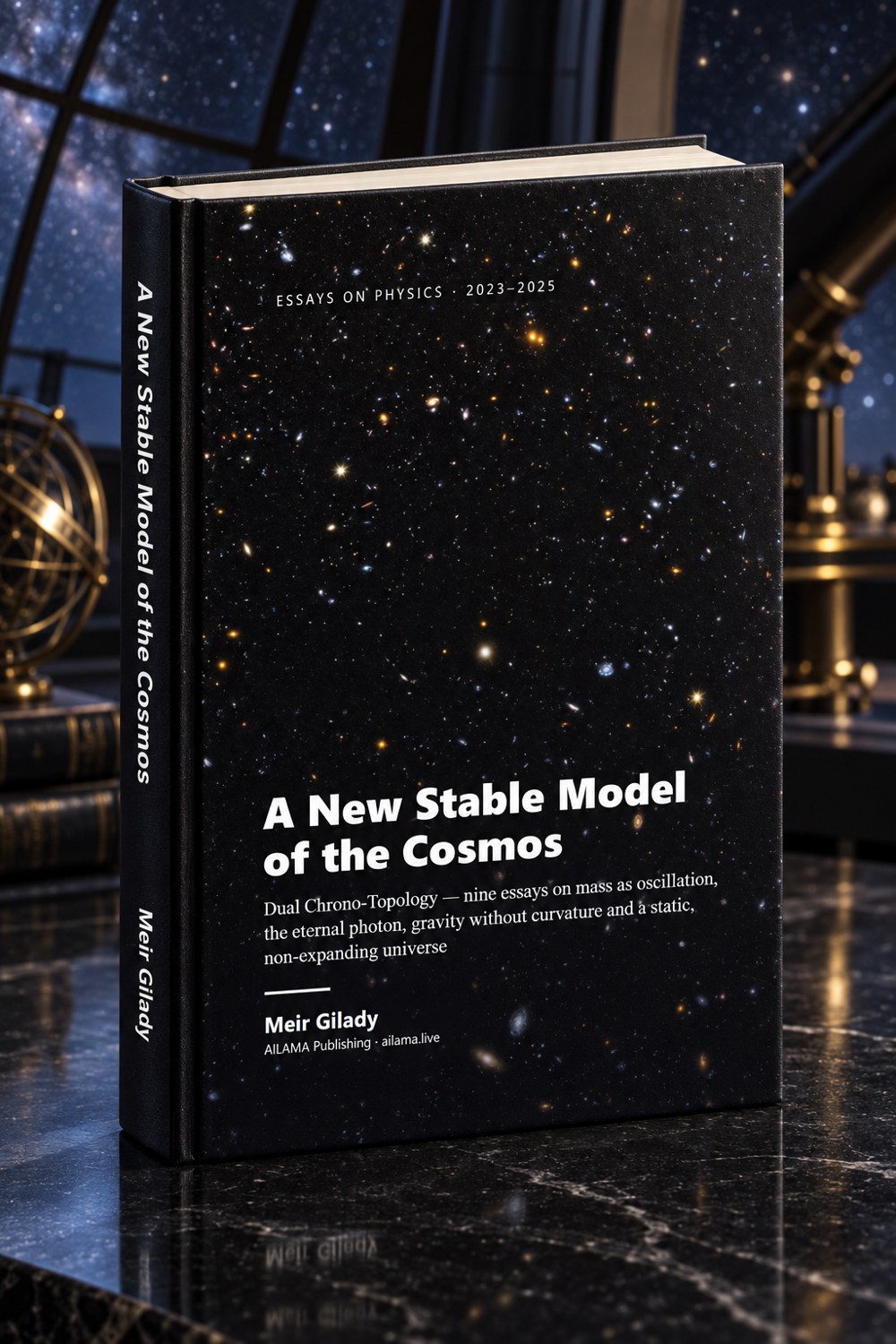
A New Stable Model of the Cosmos
Dual Chrono-Topology — nine essays on mass as oscillation, the eternal photon, and the geometry beneath the Standard Model.
$19.90 one-time · PDF e-book · 42 pages · instant download
What if time itself is not one thing?
Quantum mechanics describes the very small with astonishing precision; general relativity describes the very large with equal precision — and the two refuse to speak the same language. These essays ask a simpler question underneath that wall: what if matter carries two clocks — the forward time we experience, and a mirror-time bound up in the topology of particles, the 720-degree turn a spinor needs to come home?
From that single geometric premise the book reaches for larger claims:
Mass is a frequency
Rest mass as the rate at which a particle flickers between its two time states — not a substance, an oscillation.
The eternal photon
Why light does not age: a particle that never switches clocks has no internal time to lose.
Gravity without curvature
Gravitational confinement as asymmetric spatial compression — a vector-superposition picture of attraction.
A static universe
Redshift as a topological interaction along the path of light, instead of cosmic expansion.
What's inside
Part I — Early notes (2023): four short pieces, the first sketches of the two-clock idea, kept in their original form so you can watch it grow.
Part II — The Dual Chrono-Topology papers (2025):
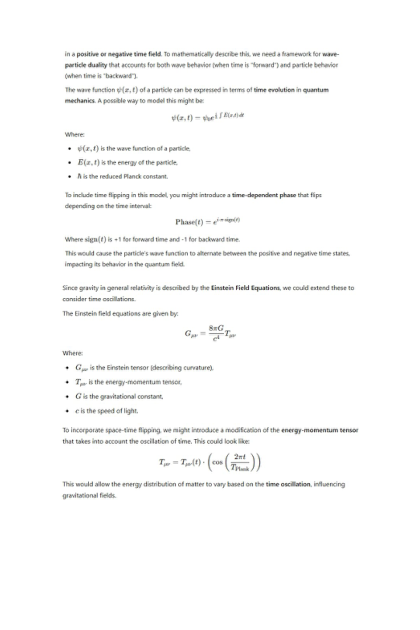
- Space-time back and forth?
- Time and space
- Black holes don't have a mass of their own
- Casimir effect
- Dual Chrono-Topology: The Mirror Universe and the Eternal Photon
- Proposal: The Dual Chrono-Topology of Matter
- The Unified Chrono-Topological Field Theory (UCTFT)
- Gravitational Confinement via Asymmetric Spatial Compression
- Dual-Chrono Topology: A Unified Model for a Static Universe
Who this is for
Readers with a first-year-physics background who enjoy a bold idea argued carefully: students, engineers, science teachers, and the many "amateur physicists" who never stopped asking why. Equations appear where they help; the argument is in the prose.
A note on scope. These are speculative, independently written essays. They have not been peer-reviewed and are offered as a line of thought — a set of geometric intuitions about time, mass and cosmology — rather than as established physics. Where the essays make quantitative claims, readers are encouraged to test them.
About the author
Meir Gilady is an Israeli entrepreneur and independent thinker based in Holon. Alongside a career in commercial real estate he builds software under the AILAMA name — including AILAMA Mind and ToolVerse — and writes about physics, technology and everyday wellbeing on Medium.
Questions
Which format? A PDF laid out for 6×9 in — reads well on a tablet, laptop or printed. Refunds? Full refund within 60 days, from the link in your Digistore24 receipt. Can I read some of it first? Yes — all essays are on Medium; the book collects, orders and formats them with a new preface.